
|
|
| "Guys
love it when women suffer to be beautiful." This seemingly masochistic
quip came straight from the mouth of my otherwise loving and liberal boyfriend
as we were mingling around a fetish party, but before I launched into a
defensive argument, I noted a cramp developing in high heeled foot, felt
the hair pins performing a sort of amateur acupuncture to my scalp and suppressed
an overwhelming desire to check my lipstick. And then, of course, there
was the custom-made corset I was sporting, maybe I wasn't exactly suffering,
(it looked killer) but I sure as heck was standing up pretty straight. Was
he right? Has fashion always been about physical extremes? Have women continuously
girded and gathered, masked and mashed their form just to catch some guy's
eye? We needed a lesson in couture 101, subject: corsets. |
 |
 |
| Mia Hamm and the
Venus sisters have nothing on ancient women. Every bit as physically active
in sports, dance and gymnastics as their male counterparts, what they lacked
was today's bosom-flattening, shoulder straightening sports bra. The need
for muscle support gave birth to an early form of corsets. Cretan women
cinched rings around their waist. Greek babes banded their bodies with zonas,
or woolen tube tops, if you will. Plus, the ancients being the key purveyors
of classical form, the idea of flesh parts just flopping around didn't fly.
Everything had to be column orderly. Suddenly, the torso became the focal
point, the secondary sex characteristic that everybody could get "hip"
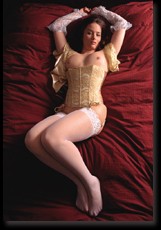
with. Not much changed for hundreds of years, the fashion industry wasn't even an industry, it was just what people wore. Thank God for the Crusades that kept all kinds of nifty textiles and spices pouring into Europe. Soon, the expression "clothes make the man," took hold. Spearheaded by Italian Princess Catherine De Medici, court decorum dictated whose waist could be so wide. Fair maidens began to mimic knight's suits of armor, wearing iron-forged corsets, hinged on the sides, outside their clothes. Talk about your heavy metal babes. The hourglass style had struck a note and was now all the rage. Huge bustling skirts were topped with stomach scrunching corsets or under bodices that derived their strength from strips of material fortified with paste. The complicated lacing moved from the sides to the front and back. Busks were used to hide the mechanics and added pads called basques further elongated the silhouette. The exaggerated female form was in full swing by the 15th and 16th century. |
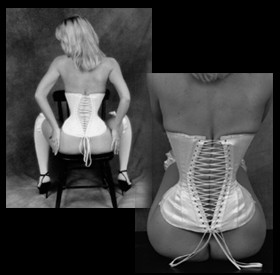 |
But damn those pesky 17th century Puritans with their self-sacrificing ways! Under their influence, extravagant garb was shunned, but elaborate undergarments still prevailed, despite bans on imported materials. The busks came into its own and started making a more overt appearance. Constructed of wood, metal, or whalebone, they often doubled as fans or weapons. By the time of Louis the XIV, pompous, outlandish couture was back in the house. This time, shoulder straps were added to corsets that hit just below the bust: bosoms swelled to eye-popping proportions, as did a taste for reckless pleasure and wild abandonment. Soon after, power-wielding queens, such as Catherine the Great and Empress Maria Theresa of Austria dictated fashion decorum. All eyes turned to highly adorned and decorated corsets that made for a slim silhouette aided by a long, pointed front. |
| The late 18th
century saw a loosening of attire ala an airy rococo aesthetic. With the
introduction of printed cotton, dresses became more free flowing and less
restrictive. European royalty took to modeling themselves on peasants, dressing
in farmy-type frocks and frivolously playing milkmaid and attending flocks
of sheep at their faux country chateaux. For a while, corsets were on the
shelf. By the early 19th century, rigid hourglass wear was back, and with the invention of metallic eyelets, corsets could bear more strain, and so-called tight lacing was born. Now a two-person dressing process, much marital intrigue and infidelity was revealed as husbands' noticed that their wives were laced-up differently than how they left them in the morning. Here we also get the advent of the fainting couches, places of respite for women so bound up they could scarcely catch their breath. By 1840, a lady in full evening attire was essentially useless for any task but posing. The complicated rigging of suspenders and garters and the ship bow-like bust, tempting as it was, presented a formidable barrier for any would-be suitor. This beauteous inaccessibility did much to fan the fires of sexual imagination and no doubt gave rise the fetishistic "look but don't touch" appeal we've come to associate with corsets. The fevered pitch of corset fashion finally broke at the turn-of-the-century: physicians concerns, a growing sense of injustice perpetrated on women, and a return to a healthy, outdoor lifestyle spelled quits for the antiquated garments, but not entirely. Sports corsets made of durable jersey and modified loose fitting corselets came onto the scene and continued to offer a smooth, slender and supported figure. 1910 saw a concerted effort to rid women of the strangling sub clothes. The outbreak of World War I signaled the death knell for the complicated, rib bruising garments. With factory work to be done and ostentatious dress summarily frowned upon, women saw hems rise and corsets replaced by light slips or pushed down in the form of a stretchy girdles. By now, the outward appearance of men and women, so long strictly delineated, became less differentiated. Women now wore pants, cropped their hair, smoked, drank and staying out all hours sans chaperon. They were fast becoming one of the boys, flat chested and all. |
|
While the super cinched waist was a thing of the past, the invention of the flirtatious bustier began to breathe life into the female form again. 50's starlets such as Jayne Mansfield, Mamie Van Doren and Gina Lollobrigida started projecting, literally, a spectacular bust line. Some attribute this push for huge, mommy-sized mammary glands to returning GI's seeking comfort and security. In any case, the hyperbolic bust loomed large on the home front. All that Russ Meyer fodder got deflated when the freewheeling, liberating 60's got underway. Bras were burnt as a symbol of sexism and a whole generation of girls who came-of-age in soft, comfortable underclothes weren't about to settle for anything less. Twiggy-esque figures, veritable stick bugs were the stuff of groovy mod fantasies. Whether wrapped in artsy black pullovers ala Edie Sedgewick or draped in hippy-dippy Indian print dresses, the look of the day was anything goes, youth-quake chic. |
 |
| The 70's witnessed
just as much an un-sculpted body shape. Woody Allen's Annie Hall set the
tone is her mannish, slightly sloppy attire. By the 80's, curves were back
with a vengeance. Forward thinking designers such as Thierry Mugler, Jean-Paul
Gaultier and Vivienne West wood were heralding the return of the female
shape. Punk rock ushered in the invention of bondage wear which also helped
revive interest in a belted, buckled, skintight mode as well quickly embraced
by the likes of Wendy O'Williams and kind. By the 90's, Hollywood's It Girls,
such as Winona Rider, Kate Winslet, Drew Barrymore and slews of emaciated,
heroin addict-affecting supermodels were strutting down the catwalk in corset
inspired couture. This summer saw Anti-Christ Superstar, goth-metal head,
Marilyn Manson skulking about in a black, underbust for his OzFest debut. The obvious fetishistic appeal of corsets has, despite its rise and fall in popular fashion, remained strong. From the Mistress at the English Boarding School to Gibson Girls and Mae West, from Betty Page and 50's pin-ups to Madonna's unforgettable vogue-ing, sexual innuendo has no better friend than the seemingly impenetrable corset. Today, tight lacing enthusiasts, Victoriana aficionados, hip club kids, fetish and Goth scenesters, sex workers and even everyday women looking to recapture their youthful figure are slipping into corsets as a way to glamorize, eroticize and accentuate the positive. Viva la wasp waist! |
 |
Article by Mae South Models |
 |
|
Back to Kink
Menu
|