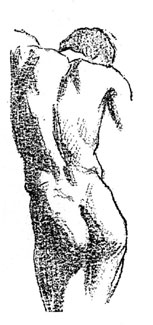

In Greek art, the male human nude was used as a canon of human perfection. The sensuous male form in motion was considered the crowning achievement of Greek sculpture. Its asymmetrical balance, this motion while at rest, and the resulting harmony of opposites is the essence of male beauty.

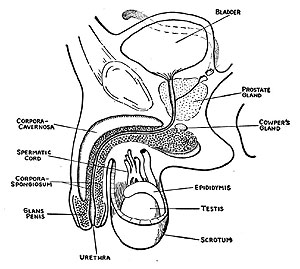
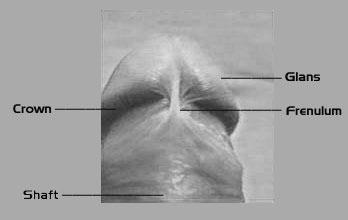
The penis is the male organ that is responsible for the transmission of urine and semen from the body. It is an expanding flexible rod which, splits into an Y and is attached to the underside of the pubic bone. It consists of fibrous tissue, nerves, blood vessels, and three cylinders of erectile tissue. This tissue soaks up blood and expands when the brain signals certain arteries to begin pumping blood through, which produces an erection. The purpose of an erection is to allow the penis to become firm enough to enter a vagina.

The scrotum is a loose sac of skin, fascia, and smooth muscle that encloses and supports the testes outside the body at an optimum temperature for the production of sperm. The scrotum is divided into two parts with each containing a testis. The testes produce sperm and the sex hormone testosterone
.
"In most men the left testis hangs somewhat lower than the right one, although the opposite may sometimes occur." (Byer 153) When the environmental temperature is low the testes move closer to the body by way of the spermatic cord and relaxes when the temperature is too high and moves away from the body. The spermatic cord is covered with skeletal muscle and it suspends the testes in place.

The genital ducts of the male reproductive tract carry the mature sperm from the testes to the exterior of the body. It is a straight tube located within the spermatic cord. A vasectomy (male sterilization) is the surgical removal, or interruption of a section of the vas deferens, followed by the sealing or tying of each end.

The urethra is a small tube extending from the bottom of the urinary bladder to the exterior of the body. Its function is to convey both urine and semen to the exterior of the body, each at different times.

The fluid-producing glands include the seminal vesicle, the prostate, and the Cowper's glands. These glands can also be referred to as accessory glands. The seminal vesicles secrete a viscous, alkaline fluid rich in fructose, which serves to nourish and protect the sperm. This secretion constitutes more than half the bulk of semen.

Semen is a grayish white, sticky mixture that consists of sperm and other fluids from the accessory glands. The prostate gland secretes a milky, alkaline fluid that is essential in the neutralization of the acidity in the vagina during intercourse. The Cowper's glands secrete an alkaline, mucous-containing fluid into the penile urethra that is lubricating and protective and adds to the bulk of the semen.

An ejaculation is the process by which semen is ejected from the body and is a spinal reflex like an erection. An orgasm, which is an intense pleasurable sensation, usually follows an ejaculation. Although, some men report that for them ejaculation and orgasms do not always occur simultaneously.


"For we are lovers of the beautiful, yet with simplicity, and we cultivate the mind without loss of manliness." - Pericles

Return to All About Men Menu

Copyright © 2003 Sssh.Com • All International Rights Reserved