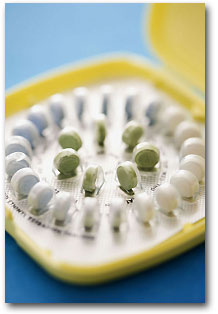
McCormick wanted Pincus to develop a contraceptive method that women could administer and control on their own. Pincus teamed up with John Rock, a Roman Catholic gynecologist at Harvard Medical School. Together they developed a synthetic steroid tablet which was first tested on women in Puerto Rico. Soon after, the Searle pharmaceutical company agreed to market the first oral contraceptive product in the United States under the brand name Enovid.
Executives at Searle were made aware that the pill had many potentially dangerous side effects (inclduing nausea, headaches, dizziness, heart problems, and cancer), but they marketed the new drug aggressively. One newsletter distributed to Searle salesmen advised them to "weed out all the negative points and convince doctors to get patients started on Enovid TODAY." Even as the pharmaceutical company may have been motivated by profit potential, it was abundantly clear that the Pill was going to signal al breakthrough in women's equality, and its significance as a drug was equal to its significance as a tool for social change. At last, women had control over their own reproductive cycles and choices. As news spread of its effectiveness and availability, its popularity spread like wildfire. By 1962, nearly 1.2 million women were using the Pill.
"In its effects I believe that the pill ranks in importance with the discovery of fire," wrote philosopher Ashley Montagu; others compared it with the invention of the printing press. Montagu theorized that the pill would empower women and make premarital sex acceptable, as well as eliminate the American male's "predatory exploitative attitude toward the female," thus allowing for the overall "rehumanization" of mankind. Pretty lofty language, but then, this was a very exciting invention that changed everything, and quickly.
When Kennedy became president in 1961, Margaret Sanger felt sure his catholic upbringing would make him antagonistic towards the Pill or birth control in general. But Kennedy was a progressive president who believed strongly in the separation of church and state. He also believed in population control as many politicians of the time did (fearing a connection between rising world populations and the spread of socialism), and in 1963 Congress approved $80,000 for population control research. Former president Dwight Eisenhower became an honorary president of Planned Parenthood. Everywhere it seemed the public was very supportive of the Pill. Oddly enough, however, birth control was still illegal in many states throughout the 1960s, including New York. This was appalling to William Baird, a man who became a crusader for the rights of women to control their reproductive freedom. Baird was raised in a large family and saw first-hand the ravages of poverty in his community. He worked with a pharmaceutical firm that manufactured contraceptive foam, and was shocked when visiting a hospital in Harlem to see how unwanted pregnancies and illegal abortions ruined the lives of many women. He offered his services to Planned Parenthood but was ignored. He crusaded to educate poor communities about birth control and the dangers of trying to terminate pregnancies at home, and was arrested a number of times. He later founded a clinic for a poor, predominantly black community on Long Island, and was helped by his friends Abbie Hoffman and Paul Krassner prior to his imprisonment for twenty years for "indecent exposure of obscene objects." His last arrest occurred in Freehold, NJ, where he went to protest the decision by then-welfare commissioner Marcus Dailey to put unwed mothers in prison under the fornication statute, in an attempt to lower welfare costs.
The Pill became a cultural phenomenon but was not widely taken notice of by the media until 1965. By then a real cultural divide over sex was taking place: how could a country that popularized Sex and the Single Girl, topless dancing, Playboy magazine and x-rated films still have states in which birth control was outlawed? The Pill was poised to change everyone's attitudes and practices with regard to sex. As Redbook the popular women's magazine stated, "Since the pill can be taken any time of day, and since it does not involve contact with the genitals, and since it is taken on a regular schedule whether one plans immediately to make love or not, it can be used without full awareness that one is preparing oneself for intercourse." Time magazine declared the Pill "a miraculous tablet." Gloria Steinem, then a popular leader in women's rights, wrote about the Pill for Esquire magazine: "For one thing, it is more aesthetic than mechanical devices and, because it works chemically to prevent ovulation, it can be taken at a time completely removed from intercourse." It was said to be 100 percent safe, and 100 percent effective (if used properly).
Since there was so much enthusiasm about the Pill, women and their doctors began to more or less reject and almost forget the earlier methods they'd used; suddenly the diaphragm seemed awkward and uncomfortable to use, and interfered with any chance of sexual spontaneity. Social norms were changing. "Nice girls" didn't have sex on the first date in the 1950s; but in the 1960s, it became more or less expected that women would have sex under very casual, even anonymous circumstances: at outdoor rock concerts, for example, or parties. But even as the Pill made sex easy, it also made it easier to be discreet about it. Since women now had more confident control over their reproductive cycles, they could also exercise greater control over their relationships and career choices. Birth rates in the United States slowed for quite a number of years in the late 1960s and early 1970s. But still birth control remained illegal in places.
Since neither the Constitution nor the Bill of Rights had any clear statements on morality or laws concerning sexuality, proponents of birth control had to find a creative way to challenge these laws that kept women and men from exercising reproductive freedom. Inspired though he may have been, Baird was too controversial to be a spokesperson; a woman was needed, and a Catholic one if possible. Estelle Griswold was just the woman for the job: a dignified, matronly sort from Connecticut who took control of that state's Planned Parenthood League. She knew little about birth control when she took this job in her 60s, but soon became excited at helping overturn the state's birth control statutes. Married couples in Connecticut were under the law forbidden to use anything that could prevent conception; they could be arrested for using a condom. Griswold thought this sort of law was a violation of privacy and ridiculously archaic. At first she tried pointing out that, with its low birth rates, the state's residents were already flouting the law. She then tried to sue the state on behalf of women whose health would be endangered if they gave birth. Finally in 1961 she opened an illegal birth control clinic in New Haven, staffed with volunteer doctors. She was arrested and her case was heard before many courts until finally reaching the Supreme Court in 1965. Connecticut's ban on contraception was struck down by a 7-2 vote.
That same year, national news headlines told of a university physician who prescribed birth control pills for two college students, and the issue of parental consent for birth control became a topic of national debate. It was believed college physicians (most of whom were male) felt more comfortable prescribing the Pill than fitting young women for a diaphragm; as long as their treatment was "hands off" they could avoid feeling that they were somehow condoning young female students' sexual activity.
Also in 1965, the NAACP declared that the Pill was a symbol of black genocide, since it would invariably lead to lower birth rates for black Americans. This was mostly the belief of black nationalists, but experiments conducted by the government at Tuskegee and the overhaul of the welfare state had many African-Americans paranoid that the government was doing what it could to oppress them. It was rumored that there were two birth control pills: one for white women and one for black women, and that the latter caused sterilization.
These issues highlight the fact that Pill's controversy is a natural outgrowth of its effectiveness. If it had not been such an important invention, so much social upheaval would never have resulted from it. In his article "The Pill: A Prescription for Equality" author David Allyn states that the advent of the Pill and the victory in the Griswold v. State of Connecticut were both victories for secular humanism. Other than the catholic church, which still opposes birth control, no other church denominations oppose it on moral grounds. Indeed, the much larger problem today is opposition to abortion. Despite its reliability, the Pill is not always 100% effective in preventing pregnancy, and today women who face unwanted pregnancies are increasingly facing challenges in terminating them. But that's another article.
The Pill has undergone many innovations since its invention. Concern over its rare but serious side effects has led to the development of low-estrogen dose pills, which have lower risks of stroke and heart attack. Lesser side effects, such as weight gain, nausea, irritability and loss of libido, have also been addressed in the development of pills with differing levels of hormones. The Pill continues to be the number one choice for birth control for women aged 18-35.
Copyright © 2007 Sssh.Com • All International Rights Reserved
You may not distribute or reprint this article, in whole or in part,
without express permission from Sssh.Com
|
|