I've
been really redoubling my efforts at Good
Vibrations [a San Francisco-based sex toy storefront and mail order
catalog] because there's some staff shifts that have been happening lately
that have kind of shifted me into the role of being the primary spokesperson
for certain of our projects, including National Masturbation Month. May
is National Masturbation Month. It actually takes about a quarter of a year
to get the PR out there and talk about masturbation to the magazines with
the longest lead times. So I find that I'm talking masturbation annually
now from January through May, at least. Almost half the year.
At Good Vibes I sort of wear two hats. For a long time I've been the Director
of Continuing Education, which means that I take my sexology background
and contacts in the community and put together monthly educational evenings
for the staff. So, as far as I know, we're still the only retail store that
does this so that when a person calls up with a very particular sexual issue
- say, a transsexual woman calls wanting to know what kind of dildos would
be best for her to use as vaginal expanders - things like that. so that
the physiology of the transgendered woman is clear to the person she's talking
to, that would be one example. Situations like, which is very common actually,
the person who doesn't actually know an awful lot about sexual anatomy and
is trying to figure out why they're not cuming adequately or different things.
And there are still people in this day and age who are not exactly clear
on what the clitoris is, never mind the G-Spot.
And of course, as years go by we get more
and more and more men customers and far from being a solely woman focused
place, which some people still think it is, we really think of our customer
base as people who are interested in sex and that covers pretty much everybody,
except for those few people who are interested in sex only so that they
can bitch about what other people are doing. We don't have much for them
but they tend to like to order SM books and get themselves really worked
up. So, perhaps we're even making a little money off of those folks.
The whole idea was that we could really
do a good job with customers' questions when they call to ask. We, in
our Mission Statement, have education before we talk about being a retail
space and making money to sustain ourselves. And, of course, we're a worker
co-operative now and have been for the past several years, which means
me and 15 of my dearest colleagues are co-owners of the business and we
work all together in terms of the direction of the business and that sort
of thing.
And the other thing that I do at Good Vibes
is marketing. I'm the marketer! And what that means, of course, is talking
to the press about sex all the time. I probably have the sweetest marketing
deal in the whole universe. I don't have to try to promote SUV's whose
tires blow up. I don't have any moral or ethical qualms about the kind
of marketing that I do. And I try not to not only get the name of the
company out there, we've got a whole marketing department to do that,
but also to help further position us in people's minds as a sex toy company
that knows about sexuality and is an appropriate place to ask questions.
From the special events that I do, like
video clip shows or Masturbation Month special events to get attention
for the company. I helped produce Annie Sprinkle this last Masturbation
Month do a show. She's a masturbation goddess for so many. Not just for
her own masturbation habits and facilities, but also as an erotic star
and real sex positive goddess. So, we figured, "Wow, who better to
get on the stage in the Castro theater than Annie." And it was great!
So, I do those kinds of things. And then I just sit at my desk and chat
with people from Men's Health and Cosmo and talk to the TV stations that
are progressive enough to want to put something about sex on that isn't
completely focused on titillation.
Not that I have anything at all against
titillation. Don't get me wrong. But the thing that I really noticed is
that certain shows would like to sort of construct the sex community in
the image of what they think the sex community should be and what they
want to put on television to attract viewers, like the experience that
you had with the Playboy Channel. Whereas others are much more willing
to say, "Tell us what you're about. Show us what you've got. What's
this corner of the sex community all about, let's see if we can document
it to show those people who don't know it's here." I've really had
wonderful experiences with Canadian TV along these lines. U.S. TV is a
little more constructionist about the way that they like to do documentaries.
It's been a really fascinating situation to be in a position where I am
sort of talking about the same set of things a lot to very different media
outlets. It's very interesting to see how the different people, different
journalists, different kinds of magazines and so forth want to pitch things.
It's not surprising that people are confused by sexuality in this country
because it's some different thing depending on where you look. It's certainly
not a unified topic. It depends on where your point of entry is. Is it
through the community, through the media. where is it?
That's what I do at Good Vibes. That's
my day job. I work there half time and, theoretically, that gives me a
lot of time to work on my writing projects and the other kinds of things
that I do.
Darklady: Does Good
Vibrations have any new ventures it's working on?
Carol Queen:
I'm involved in a project now to help lay the groundwork for us to make
our own videos, for example, which is going to be an exciting thing when
we get that off the ground, which we hope we will do next year. We want
to do both educational videos and we also want to do erotic videos which
will fill gaps in the market that we know are underrepresented. We've
talked about doing videos for more "full-figured" people and
have talked about that not necessarily being a line that we produced but
that we would at least want to mix up the body types in the videos we
make, which in some ways would be a better thing than just doing fat girl
or fat guy videos. But, at least doing big videos that don't have that
sort of sense of smarmy, "we're going to make fun of these people
as we watch them fuck," context that is so frequent in that genre.
Transgendered folks have much the same
issue with much mainstream video. It's like, "oh, look at the specialty
tape." For that community, this is not a specialty thing, this is
their identity and it's harder to integrate our ideas about who's sexy
if all we ever see are the same body types, the same age range. It just
goes without saying that if we get a chance to see a wider erotic range,
we can more easily eroticize a wider erotic range and we can more easily
take seriously various peoples' eroticism. So it's all part of the high-minded
goal of focusing on erotic diversity and making people feel good and comfortable
about that, whether we're doing it as specifically educational or whether
we're trying to put good erotic material out there into the marketplace.
And there are people who are trying to do nice things out here, certainly.
But it's all still pretty much fitting into this category that says, "specialty,"
all non-mainstream still. So, we would like to have an effect on the industry
that way, actually.
I think that we've had an effect on the
industry as far as sex toys are concerned. Many of the distributors take
our input very seriously now. We were one of the very first places that
let people bring back toys that they were disgusted with and say, "Hey,
this didn't work! This isn't any good!" And we tried the toys out
ourselves to make sure that we thought that they would work in the first
place. We turned away more things than we actually accepted for the store.
It's still true. A traditional sort of adult bookstore type, porn magazine,
video and toy store of the sort that is mostly out there still will pretty
much get stuff from distributors and stick it on a shelf. They let the
distributor kind of tell them what to carry. We've never done that. We've
always read the books, watched the videos, played with the toys, evaluated
them, filled out a little form, put the form on file and then either carried
the toy or said, "Nah, this is not for us or our customer base."
So those kinds of things, no matter what we carry, are always of interest.
And if we ever branch out into actually manufacturing toys, what we'll
do is follow up on the tons of feedback that we've got over the years
around what people with that they could find, about the things that people
think are good and not so good about the toys that are out there now.
 |
Darklady:
Could you tell me some more about Best Bisexual Erotica?
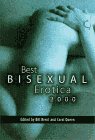
Carol Queen: Best Bisexual Erotica
is a book that just came out this spring [2000]. It was co-published
by my co-editor, Bill Brent's Black Books Press -- he self publishes
his Black Book of sexuality resources, as well as Black Sheets, the
terrific pansexual 'zine - and Cecilia Tan's Circlet Press out of
Boston. So it's not only bisexual, it's also bicoastal, as well! It's
a nice, hefty book with a lot of stories, over 20 stories in it.
The last decade has been a real flowering of erotic literature, especially
in the anthology context. About mid-decade it started a trend toward
sort of specialty anthologies that either looked at a particular kind
of eroticism or had some other hook, like |
Thomas Rush's Noir Erotic series which is erotic
crime stories. Even M. Christian's book, Midsummer Night's Dreams, I think
it's called, takes Shakespeare's Midsummer Night's Dream and riffs off of
it erotically. There's lesbian fairy tales, gay male fairy tales, African-American
writers, Asian-American writers, all these different niche identity eroticisms
which, in my view, you can't read just one if you want to know what's going
on in the erotic world today. You have to sample pretty liberally throughout
these various kinds of anthologies and the publications that tend to feed
them and see what people in different corners are doing because, again,
it's a diverse realm out there, the sexual realm. Susie Bright, of course,
many years ago started doing Best American Erotica and a few years later
Cleis Press started publishing Best Lesbian and Best Gay Erotica annual
anthologies. All three of these have been annuals. In particular, Best American
Erotica has really been a good venue for bisexual writers and readers because
it's a mixed thing.
So, bisexuals could read Best American Erotica because there was some gay,
some straight, some bi, some this, some that, some of the other things and
bisexuals tend to have a fairly wide ranging appreciation for different
kinds of erotic literature since we have a wider range in appreciation for
different eroticisms, at least across the supposedly two genders. And yet
there was nothing specifically in print for the bisexual reader in which,
for example, the protagonists of the stories were pretty much all bi and
the various issues and erotic situations that might be especially appreciated
or related to by the bisexual reader - where were those? Those were out
there but not collected together.
So Bill and I decided, 'Well fine. Enough
of all that. Let's rectify this situation, this big gap in the literature."
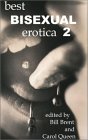
So we did Best Bisexual Erotica, which may turn out to be maybe not an
annual but certainly a series of books. There are so many great bi writers
out there and we've only scratched the surface here. I think that a lot
of people appreciate bisexual erotica. Bisexual people, of course, have
a little more to relate to in those scenarios at least potentially. But
I think there's such an enormous amount of curiosity, erotic interest,
what we've been calling bi-curiosity within the bi community, at least.
So many bi-curious people out there who aren't prepared to say, "Yes,
I'm bisexual," but given an erotic scenario in a video or especially
to read in a book find it pretty fascinating, pretty erotically compelling.
So, I think there really is a future for bisexual erotica.
I think the stories that we got for Best
Bi were often very inventive and really excellent. Definitely a lot of
the author's perspectives helping to shape some new and interesting scenarios.
Plus, most of this we didn't publish, but we got a ton of very well-written,
thoughtful, good, but not too overtly sexual bi stories that sort of explored
relationship dynamics and things like that. We could almost have done
another volume of bisexual stories. I think that there's enough momentum
now in the bisexual communities to fuel, not just give readers to the
writers, but also to create more writers who are willing to use bisexual
characters in scenarios. There's a little more of a "there"
there than there was even a decade ago and I don't see that changing,
especially thanks to the medium of the Internet that allows people to
talk to one another over great space and allows people to sort of orient
and identify even if they don't have a community where they are. So, I
think that there's really a great deal of community strengthening and
formation that's happening via the Internet. And people who are gonna
log onto the Internet are mostly readers. If you're not a reader then
you're just looking for the picture sites and then logging off. But if
you get on the lists or engage in the chat groups or read the stories
on alt.sex.story.whatever, you're a reader and I think that giving the
death knell of the book is a bit premature, although we'll see what happens
in the next twenty years or so.
Darklady:
Where are the bisexuals coming from?
Carol Queen: If you look at Kinsey's
numbers, if they're even remotely correct, and our best indications
say they are, so maybe 10% of the population is predominantly gay
or lesbian, that's where we get that number, it's an extrapolation
from Kinsey. But Kinsey's numbers indicate that 30 - 50% of the population
has had bisexual experience and we don't know what percentage of that
identify firmly as bisexual. But you can figure at least another 10%
if not more.
If you stop and think, then if a lot of the people who identify as
being gay or lesbian also have significant bisexual experience, and
then a whole bunch of people who identify as heterosexual or bi-curious
or who have had incidental bi experience that they don't |
 |
regret, that's a pretty big group of people
to potentially feel interested in and be consumers of this kind of stuff.
I don't feel like we're going to be hurting for readers. When I say that
there's more "there" there, it's partly because the bisexual community
itself has made more space, more institutions are becoming available, the
Internet is an important part of this. And we have seen some real strides
against homophobia in the culture in the last decade/decade and a half,
although there is still plenty to go around.
Darklady: That's true. But what about how gays
and lesbians view bisexuals?
Carol Queen:
When people relax about homophobia they, by definition, have relaxed at
least a little bit about biphobia, although there's still people, gay
and straight, who tell us we're confused because they, themselves, can
not imagine being us. Therefore it is really they that are confused but
why slap back? Living well is the best revenge! And it's easier now, I
think, to live well, than it was a decade ago when it was much harder
to find connection and space within the queer community. I mean, this
whole notion of queer as opposed to gay and lesbian and bi and transsexual
and questioning and friends, etc., etc., etc., helped keep the door open
at least a little bit.
Using "queer" as an umbrella
term to encompass bisexual people, gay men, lesbians and sometimes transgendered
people. Some trans people don't necessarily want to be put under that
umbrella and others, especially those who are a little more radical about
the notion that they might be neither gender or both or "What do
you mean two?" You know, who have a more radical and exploded notion
about gender. Those people might feel pretty fine being termed queer.
And plenty of heterosexual people these days are comfortable thinking
of themselves as being queer - even if lesbians and gay men would rather
not have heterosexual people come into the queer community. It really
shows where the resistances and prejudices in identity politics are, as
well as the very positive ways that identity politics helps people find
each other and get into supportive communities.
Boy oh, boy, you don't hear much about
"heterophobia," and I always put quotes around that anyway,
because it certainly doesn't have the kind of institutional power and
viciousness that homophobia has. But on an individual and community level,
it can be just as bitchy, vicious and exclusionary. And that is really
one of the not always talked about things that make up biphobia, especially
as the gay and lesbian community tend to express it. It's not the bisexuality
per se, it's the proximity to heterosexuality and heterosexually coded
choices.
In the queer community, there have been
so many people who have tried to be straight and not been able to do so
that I think it's entirely understandable that there's this tension and
defensiveness. I just think it's really a shame. In any venue people assume
from their own experience that they can understand and therefore judge
other people. We see it in the feminist community when we talk about sex
work, we see it in the queer community when we talk about bisexuals, it's
just all over the place and it's unfortunate. It's not a character of
strength.
Darklady: Do you think
books like Best Bisexual Erotica can help people understand us a bit better?
Carol Queen:
It's really interesting reading through Best Bisexual Erotica because
there's plenty of hot bi sex, of course. But there's perhaps even more
than Bill and I expected when we solicited the stories. Also, a lot of
information and speculation about bisexual relationship issues, which,
of course, is when you get down to it, when you just really shake it down,
most people have sex kinda similarly, kinda. Ok, penises, vaginas. Ok,
whatever. Engorgement, arousal, friction, touch, the need for lubricant.
it's pretty similar across orientations and genders. Some of what seems
strange to people about bisexuality is not sex, it's relational issues.
Questions of monogamy vs. polyamory. Can you be bisexual if you have one
partner of one gender. How can that be? That tendency to conflate orientation
and relationship status, which is dangerous.
People get to be what orientation that
they are and they get to find themselves in the relationships that they
do and they don't necessarily always match as readily as someone who would
like to do a strict taxonomy might desire. You just have to let people
be who they are. In Best Bisexual Erotica you find bisexual people and
not necessarily bi-identified, but bi-behaving people being who they are
in the context, not just of their eroticism but also the way that they
connect with their lovers, the number of lovers they have, the kind of
erotic play that they might choose when they get there.
Darklady: Do you have
any favorite stories from the anthology?
Carol Queen:
A couple of really interesting stories,
to me, in Best Bisexual Erotica is the one we open with and then one quite
far back. The first one's called "First, Hello" and it's the
story of a dyke who has been having a flirtation with a guy and she finally
invites him over and there's all this first time shyness and tenderness
to it, as well, since they're obviously friends. You can get that they
probably made friends at work or something like that and they're in a
community together. You get that from the story, even though there's not
a lot said about it. Then there's, further on in the book, an interesting
companion piece to it. A love story which looks at the movement in a lesbian
couple getting into dildo play and the point at which that really brings
up gender issues and questions of bisexuality for the participants. And
that's a fairly deep level of exploring eroticism if you get down to it,
looking at how sex practices affect our orientation and gender identity
and how we see ourselves and the things that we seek out and that kind
of thing. And they're both really interesting to me, too, because I come
from a lesbian identification.
 |
Darklady: That's
true. What was that like? Changing from lesbian to bi identification?
Carol Queen:
I went from a bisexually identified to lesbian identified back to
bisexually identified because I was bisexual all along, godddamit.
It's true that you can choose an
orientation to a really substantial degree, especially if you're
bisexual and you could go either way, as the staying goes. But I
also think it's true that our choices can also overlay deeper potentials
and things we could be doing if we lived in an optimal world that
would let us explore everything we wanted maybe we wouldn't choose
either/or as often.
I know about the biphobia that's
within the lesbian community that is really intimately connected
to stuff like this. I remember the dykes in the '70s who were firmly
anti-dildo because the assumption was that if a woman got into a
dildo she could just as easily get into a guy. In my story in Best
Bi, "Like a Virgin," the story in which the lesbian approaches
Robert and me so that she can have an experience with a man, one
of the reasons I keep saying, "There's a man attached! Look,
it's a man!" is because I've definitely heard it all about
this sort of privileging of penetration.
|
That particular segment of the lesbian community,
you know, "If she gets too used to being poked she's gonna leave you
for a guy," because Lord knows we all want heterosexual privilege when
we get down to it. It's like, well, actually, some of us do what we can
to reject heterosexual privilege every chance we get and ya know. no. That
is too simplistic. And yet, when it happens, it's such an extraordinarily
fraught situation, probably more around dealing with your community and
friends than around just the sexual experience that has happened. So there
definitely are a good number of stories in there that kind of explore the
lesbian/bisexual connection and dissention. And there are a few things from
the point of view of the gay male/bisexual male discussion, too. Although
the discussion is less heavy there. It's heavier among women.
A woman's much more likely to get just drummed out of town if it turns out
that she's bisexual, as opposed to the guys who may, ya know, sorta sneer
a little bit. Half the time gay men will look at bi men and say, "Oh,
that's cool. So you could get married and have kids if you want to. Come
on down to the bath house." It's not an exclusionary category in the
same way, although for some men, certainly, it can function that way, to
some degree.
There are dykes now who are much, much more comfortable with being in common
cause and being side-by-side with bisexual women and being lovers with them.
It doesn't matter as much at all to them as it did 20 years ago. It felt
threatening because there's not only heterosexual and male privilege but
also the way in which when we come out to our parents and they cry because
we're queer because it's so hard to be queer and you know, "People
will give you a hard time and I don't want that for my baby." And that's
true. You can't deny it. You can find the most supportive communities possible
and that's good. But you can't deny that that happens a lot. So, to the
degree that everybody knows to really live a life as a dyke unsullied by
homophobia and happy, healthy, supportive - is a big challenge. Even today.
I think that the notion that somebody's girlfriend could say, "You
know, baby. This is too hard. I love you. I love your dildo. But I'm going
to go across town and I'm going to do what my mother wanted me to do,"
is always a present possibility even though it's not what most of us do.
I think it's been a problem in the gay and lesbian community of assuming
that when a bisexual person has an other gender relationship, that that
is what they're doing. When a lot of times, that's not what we're doing
at all. We refuse to get married. We have a polyamorous circle. We're doing
things as queerly as anybody else, it's just that we're two separate genders
apparently, as far as we can see from the outside. Lord knows what everybody
is calling each other in bed. And Lord knows what kind of persona play we
may be doing. Our heterosexual intercourse may be fucking our boys up the
butt. That's not necessarily seen from the outside and it's all this defensive
reaction of, "Oh, I knew she was going to go back to men." Many
of us didn't come "from men" in the first place, come on now!
That's really a much too simplistic way of looking at it, but it's still
very present and it was even more present 20 years ago when there was a
much, much, much smaller and more marginal bisexual community with which
we might affiliate. So, of course they assumed we went back to men.
Darklady: So, how is the bisexual writing community
helping change these views?
Carol Queen:
The thing that I think is really important
is that the bisexual community is in a phase of producing its own literature
and its own ideas and ideals about sex, gender and relationship. One of
the things that allowed the gay and lesbian community to grow as much as
it has in the last 20 years really was the production of a literature. The
fact that, even if you didn't have a community with which to affiliate,
you could go to the next big city over and find a book in a bookstore and
get a sense of what was possible. Those people who were the activists then
could try to organize something even in smaller cities and communities.
I lived in Oregon 20/25 years ago and one of the things we were doi ng as
a project was activists from Portland and Eugene were going to Coos Bay
and Baker City and little communities that didn't have an organization and
meeting with as many of the gay people in town as the other gay people in
town knew to invite to try to encourage people to form at least support
communities, if not actual organizations. It was like throwing stones in
the water in all the big cities in the United States almost simultaneously
and watching the ripples go out to the smaller cities and the smaller communities.
And even if we're not going to be in a position as bi people to have the
kinds of bi institutions that the gay and lesbian community has created...
Like the notion of going to a bi restaurant seems a little silly even to
me. Like, so what, exactly? Even if that isn't going to happen, and I won't
say that it isn't. That may be the next step, this level of creating our
own institutions within a large enough community to be patronizing the institutions
so it can be successful. Even if that's not the next step, we're much more
of a critical mass around numbers, ways for people to connect, information
for people to bounce off, to set their own identity level according to what
the literature says.
It's not all about literature, but its one way that we communicate that
proves we've gotten to a point of having quite a lot to say. So I think
we're only going to see more of this proliferate. There is more of a "there"
there now. Of course, there's going to be stuff that's not so much sex oriented.
But where I am in this whole picture is, being a sex writer and sexologist,
I'm going to be where the sex is and the ways that sex and relationship
interact, especially the ways we create new forms of relationship and that
already has influenced, say, the heterosexual people in the poly community
and you know that within the poly community there's an enormous amount of
bisexual community participation and affiliation, as well as influence on
those people who don't identify as bi. So, just as the gay and lesbian communities
have influenced straight people in many respects, we 're going to be doing
that, too.
My dream is that the gay and lesbian community can really embrace the fact
that we're a united front -- Lon Mabon isn't going to like to hear this
-- but to influence straight people in the kinds of choices that they can
make. Once the polarizations are less profound I think we're going to live
in a much more comfortable community. |