For an uncountable number of years, fascinating goddesses have been worshiped and studied. Most of them are powerful and beautiful, but they also seem to have their share of faults, family issues, and relationship blunders. This lends itself to prove that the female gender never seems to “have it easy”. As you read through this “Goddess Trivia” consider to yourself… Which goddess are you most like?


Pele
Pele (pronounced /pele/, (peh-leh, not pay-lay) is the Hawaiian Volcanic Goddess of Fire. She is a daughter of Haumea and Kane Milohai, and her home is believed to be the fire pit Halema'uma'u at the summit caldera of Klauea. She is known to devour the land and has the ability to both create and destroy. She has the kind of temper that can literally cause her to throw molten fire into the air! She is considered to be the goddess of volcanoes, lightning, fire, dance, and violence.

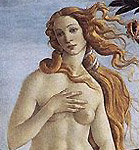
Aphrodite the classical Greek goddess of love, lust, and beauty. She was also called Kypris and Cytherea after the two places, Cyprus and Cythera, which claimed her birth. Her Roman equivalent is the goddess Venus. Myrtle, dove, sparrow, and swan are sacred to her.

Aphrodite was born of the sea foam near Paphos, Cyprus after Cronus cut off Ouranos' genitals and threw them behind him into the sea and then went back to feast on them. Hesiod's Theogony described that the genitals "were carried over the sea a long time, and white foam arose from the immortal flesh; with it a girl grew" to become Aphrodite.

She was a gorgeous and eternally young Goddess that was perfect in every way. Even though she had a perfect body, she still wore a girdle that contained magical powers to compel love. With her absolute beauty, she was extremely sexually attractive; however, she was a bit stuck on herself!

The Birth of Venus by Sandro Botticelli, 1485


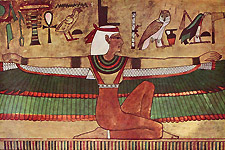
The Goddess Isis, wall painting,
ca. 1360 BCE.
Isis was the Goddess of Healing from ancient Egypt. She was also considered to be responsible for magic, motherhood, and fertility. Her father (Keb) was the god of earth, and her mother (Nut) was the goddess of the sky. She had some major family problems.

Her brother (Seth) killed her husband and brother (Osiris). Upset and determined, Isis found her dead beloved, and with her magic impregnated herself with his son (Horace). Hathor, the goddess of childbirth (who sometimes appears as a cow), was responsible for nursing Horace and hiding and protecting him from his uncle Seth.

She is capable of destroying mankind, so really, a good choice in terms of babysitting.

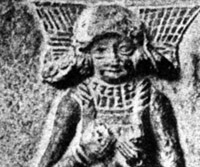
In Babylonia, Ishtar was the goddess of love, procreation, and war.  Ishtar was above all associated with sexuality: her cult involved sacred prostitution; her holy city Erech was called the "town of the sacred courtesans"; and she herself was the "courtesan of the gods". Ishtar had many lovers; however, as Guirand notes, "woe to him whom Ishtar had honoured! The fickle goddess treated her passing lovers cruelly, and the unhappy wretches usually paid dearly for the favours heaped on them." Even for the gods Ishtar's love was fatal.

She was known for interspecies relationships with a stallion, a lion, and a shepherd.  She didn’t play nice in her relationships, as she was known to destroy her lovers.  She followed the love of her life (farm god Tummuz) to the underworld, but that didn’t work out either…


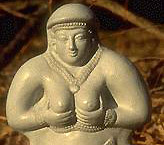
Inanna, is the Sumerian goddess of sexual love, fertility, and warfare. The Akkadians called her Ishtar.

Legend states that Inanna could be seen swaggering around the streets of her home town, dragging young men out of the taverns to have sex with her. Despite her association with mating and fertility of humans and animals, Inanna was not a mother goddess, and is rarely associated with childbirth. She was popular from the third millennium B.C. – the 6th Century.


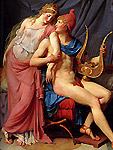
Beautiful Helen! Everyone was fighting over her! 

In Greek mythology, Helen, better known as Helen of Sparta or Helen of Troy, was daughter of Zeus and Leda, wife of king Menelaus of Sparta and sister of Castor, Polydeuces and Clytemnestra. Her abduction by Paris brought about the Trojan War.

Known as the face that launched a thousand ships, she was also rumored to have started few other wars.  She had an interesting love life.  She was married to Menelaus and had a nine year-old (Hermione), when she was kidnapped by Paris (a Trojan prince).  Arguments have been made as to whether or not she was taken willingly or raped by Paris.  Historians can’t seem to decide whether she loved him or hated him.  Perhaps she could not decide that for herself either.


Helen and Paris, by Jacques-Louis David, 1788


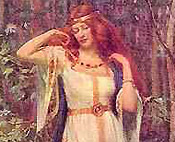
Freyja, depicted in a painting by J. Penrose.

Freyja (sometimes anglicized as Freya) was the Norse Goddess of Beauty, Love, & Destiny. Freyja with her blonde hair and blue eyes was described as the fairest of all goddesses and people prayed to her for happiness in love. She was also called on to assist childbirths and prayed to for good seasons. Freyja was also associated with war, battle, death, magic, prophecy, and wealth.

She was the daughter of the god Njord, and the sister of Freyr. Some sources claim that the word “Friday” was named after her.  She was worshiped by all kinds; men, giants, and dwarfs. By sleeping with four dwarfs she acquired the Brisings necklace. Freyja travels on a gold-bristled boar, Hildisvini, or a chariot pulled by two cats.


Perhaps you have been able to identify with more than one of these wonderful beings (or higher beings). Maybe you possess a few features from each. Regardless, while avoiding becoming a “drama queen”, I believe that it is incredibly important to always stay in touch with your inner goddess. We are all beautiful, powerful, worship-worthy, and when we need to be, terrible! Rock-on goddesses!

Footnotes:
  • Gardner, John & Maier, John Gilgamesh: Translated from the Sin-Leqi-Unninni Version, Vintage Books, Random House, New York, 1984. A column by column translation with notes and commentary following each column, by the late author of Grendel.
  • Hooke, S. H., Babylonian and Assyrian Religion, University of Oklahoma Press, Norman Oklahoma, 1963.
  • Kinnier Wilson, J. V., The Rebel Lands : an Investigation Into the Origins of Early Mesopotamian Mythology, Cambridge, Cambridge University Press, 1979.
  • McCall, Henrietta, Mesopotamian Myths University of Texas Press, Austin, 1990. A summary account of Dalley's book with nice pictures more cultural context.
  • Oppenheim, A. Leo, Ancient Mesopotamia: Portrait of a Dead Civilization, Chicato, The University of Chicago Press, 1977. This is the source for the history and culture of the Babylonians and Assyrians for the interested lay-person.
  • Wikipedia.Com
  • "Matronit: The Goddess of the Kabbala," by Raphael Patai. History of Religions, Vol. 4, No. 1. (Summer, 1964), pp. 53-68.

Return to the Sex Goddess Menu

Copyright © 2008 Sssh.Com • All International Rights Reserved
You may not distribute or reprint this article, in whole or in part,
without express permission from Sssh.Com