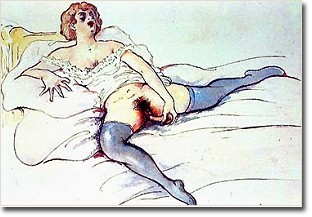
|
|
 10 - 13th Century Jade Dildo Museum of Ancient Chinese Sex Culture, Shanghai |
Women
have been pleasuring themselves for centuries. An ancient clay figurine
depicting a female masturbating was found on the island of Malta. This figurine
dates back to the 4th century BCE. Ancient phallic statuary, used symbolically
in fertility rites and rituals, may have been used in a much more concrete
manner by the priestesses. In the early mid-eastern world, women coated dried camel dung with a resin before using it to satisfy sexual cravings. This early homemade dildo evolved into the olisbos. Olisbos was the name ancient Greek merchants applied to the dildos they sold in the market. These classier versions of the camel-dung dildo were made out of various materials, including polished wood, leather, and ivory. |
| Greek women were also depicted
in art and writing masturbating. The city of Miletus, in Asia Minor, was
known for its fine craftsmanship of high-quality dildos. In Renaissance
Italy, the dildo became known as the diletto. Renaissance women used olive
oil in abundance as a handy lubricant. As the teachings of St. Paul permeated the western world, the open acceptance of female masturbation by the Greeks became a shameful and dark secret. St. Paul, Augustine, and Thomas Aquinas all contributed to the negative view of the body, and Paul in particular spread anti-female propaganda. Heterosexual intercourse for reproductive purposes was the only approved form of sexuality. |
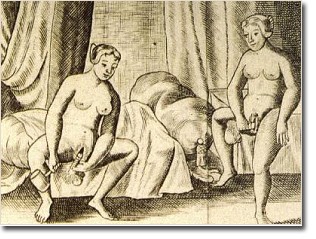 Wood Cut Artist: Unknown Date: 1680 |
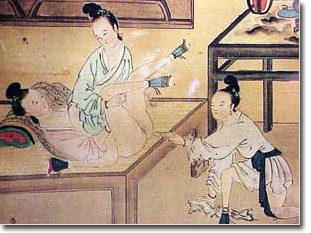 Museum of Ancient Chinese Sex Culture, Shanghai |
By the eighteenth and nineteenth
centuries, "the appeasing of lascivious excitement in females by artificial
means" was seen as mentally and physically destructive (Laqueur 229).
Masturbation became the ‘solitary vice.' It was believed to be a social
pathology that was the cause of tuberculosis and other fatal diseases. In
short, the act of masturbation was seen as an act of suicide. Strangely, although masturbation was popularly viewed as debilitating, around the middle of the nineteenth century, in the Victorian era, the rubber dildo and the vibrator were introduced. The vibrator was prescribed for that well-known psychological dysfunction, ‘hysteria.' The word hysteria comes from the Greek word for uterus, hystera. In the Victorian era, it was widely believed that all psychiatric disorders in women arose from their ‘heavy uterus.' A heavy uterus could only be cured by a doctor. |
| The doctor would vigorously
massage the affected female's genitals until she reached climax. The vibrator
was invented in order to make the altruistic doctor's job that much quicker
and easier. After the curing session, the good doctor would prescribe a
dildo as a therapeutic device. The vibrator's ‘massage therapy' label
stuck, and the vibrator has been marketed as a personal massager ever since. In the early twentieth century, vibrators were made available through Sears Roebuck and other catalogues as an aid for anxiety and feminine tension. Public awareness increased as the vibrators popularity rose, and the sexual massagers were taken out of the mainstream until their reappearance in the 1980's. |
|
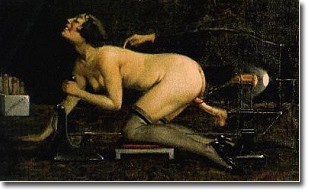 Artist: Aldo Cuvoni Date: 1928 |
Sensual boutiques focusing on
female sexuality and pleasure surfaced in the 1990's, which provided women
with an atmosphere of safety and sexual awareness. These boutiques made
it easier for women to purchase lingerie, erotic oils and devices, and much
more in a store that catered to their desires, wants, and needs. It seems that we have made a full circle and are once again, as in ancient Greek culture, accepting female masturbation as a part of life. Positive attitudes and increased awareness regarding female sexuality are on the rise. We definitely (and thankfully) have many more choices regarding sexual toys than those mid-eastern women of the past, who diligently coated their camel dung. |
|
To send Dena your comments,
please email her at dena@sssh.com |
|
References: |
|
Return to Main
Menu
|