Condoms have been made from a multitude of different materials, including tortoiseshell, animal intestines, gourds, silk and leather. They were not called condoms until 1706, but slang terms for these prophylactic devices have been in existence from the start. In England they are still referred to as "French letters." While in France they are referred to as baudruche (false optimism) or capote anglaises (english raincoat or hood).
The Middle Ages brought a great deal of communicable disease to Europe, including syphilis. An Italian anatomist named Gabrielle Fallopius claims to have invented a sheath made from linen used to help protect against the spread of the disease in the mid-1500s. It soon became apparent that the sheath also helped prevent pregnancy. Poor hygiene was rampant at this time, since most people believed bathing was harmful to the health. This was, in part responsible for the spread of the plague which killed millions across Europe. No doubt sexually-transmitted diseases were also easily spread because of poor hygiene. Prostitutes who worked in the finer brothels in Europe (as opposed to those who plied their trade in the streets) were known to urge their customers to wash between their legs before servicing them, and usually offered to do the washing themselves.
By the late 1500s, the linen sheaths were improved upon by being soaked in a chemical solution and allowed to dry before wearing; this antiseptic solution was effectively the first spermicide. The first mention of the word "cundoms" was in 1706 in a poem by an anonymous author. Believed to be named after a doctor named Condom (or perhaps Quondam) who practiced during the reign of Charles the Second (this is the king portrayed in the film The Libertine which stars Johnny Depp as John Wilmot, the Second Earl of Rochester, who died at age 33 of syphilis). Animal skin condoms were invented in the early 1700s as well, made mostly from sheep gut, but being expensive they were often reused, which may have reduced their effectiveness. Archeological evidence suggests that animal-gut condoms may have been in use as early as the English Civil War in 1647. But generally the licentious era of the Reformation is credited with this useful invention. A popular saying at the time, first written by Madame Sevigne, was that condoms proved to be "an armor against enjoyment, and a cobweb against infection." In the second half of the 18th century, there was a thriving trade in animal skin condoms and some handbill advertisements featuring them were printed.
The discovery of the vulcanization process for rubber revolutionized the manufacture of condoms. This process turns rubber, the sap from a tropical plant, into an elastic, durable material that can be mass produced cheaply. The first rubber condoms were born and have been called "rubbers" ever since, even though now they are mostly made of latex (a type of synthetic rubber). These "rubbers" were made by hand-dipping rubber cement and were not very durable. In 1861 the New York Times published an ad for "Dr. Power's French Preventatives" which marked the first advertisement for condoms in the United States. In 1873 the short-lived Comstock Law made advertising of birth control illegal, and so condoms purchased through the mail from ads could be legally confiscated by the postal service.
In 1919 a process for making condoms from hand-dipping latex rubber was pioneered by inventor Frederick Killian. These rubbers were odorless, thinner and more durable than their predecessors. They became very popular for both pregnancy prevention and protection from disease, because they did not require fitting (as some methods for women did) and were readily available. But they did require not only cooperation but action from men, and so birth control advocates saw them as somewhat unreliable. Still, by the 1930s, the 15 largest condom manufacturers were producing 1.5 million condoms per day in the U.S. The Great Depression of the 1930s made people very aware of the importance of family planning; an extra mouth to feed was a real hardship in those times of unemployment and food shortages.
In 1957, the first lubricated condom was sold by Durex in Great Britain; this is still one of the most popular brands of condom sold there. In the 1950s condoms were the most common form of birth control. But this slowly changed as the birth control pill and the IUD and coil became more popular. These methods put the obligation for birth control upon the woman instead of the man; but it is also probably true that this decline in the use of condoms also helped fuel the rise in sexually-transmitted diseases in the 1960s and 1970s.
The AIDS epidemic of the 1980s made condom use very prevalent in the USA and Europe. Condoms suddenly became available in many more places outside drugstores: grocery stores, vending machines in clubs and bars, and handed out for free by AIDS activists at social events. The first "female condom" (which works on a similar principle to a diaphragm) was invented in 1992 but has not proved to be very popular. Condom use is still very popular as women educate themselves about the risks associated with other forms of birth control like the pill, the Norplant or the IUD. Condoms made of polyurethane were invented in 1994. |
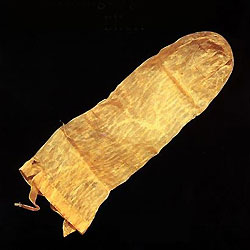
The oldest surviving condom in the world has gone on display in an Austrian museum.
The reusable condom dates back to 1640 and is completely intact, as is its orginal users' manual, written in Latin.
The manual suggests that users immerse the condom in warm milk prior to its use to avoid diseases.
The antique, found in Lund in Sweden, is made of pig intestine and is one of 250 ancient objects related to sex on display at the Tirolean County Museum in Austria this summer. [1]
|
Also lambskin condoms came back into vogue; although they do seem to prevent pregnancy as effectively as latex condoms, they are not as effective in preventing infection. These are used by men who prefer their more natural texture. Condoms now come in a large variety of colors, sizes (they used to be one size fits all!), and textures, including lubricated, ribbed and even flavored. Entire stores dedicated to condom sales, like Condomworld, also have proved popular in major cities.
The use of condoms among adolescents has been a controversial and often heated topic. School sex educators believe they should educate teens about protecting themselves against STDs and unwanted pregnancy; but the religious right wing insists that teaching abstinence from sexual activity is the only acceptable option, and there has been much lobbying to try and prevent condom distribution in schools. As the current generation of teens have not grown up beneath the spectre of AIDS, it is feared they will not practice safe sex as automatically as their parents' generation. The use of certain drugs also tends to lead to risky sexual behavior, as evidenced by the rise of AIDS infection among those who use crystal methamphetamine. Many public health campaigns are underway to try and educate crystal meth users about this danger, and to encourage free condom distribution in clubs and bars so that people can protect themselves.
Condoms will probably always have their fans, because they are just about the easiest form of birth control and STD prevention available. But who among us does not tend to still associate them with moments of adolescent awkwardness and embarrassment? Sex shops offer seminars on creative use of condoms, including showing men and women how to put them on their partner's penises without using their hands.
Copyright © 2007 Sssh.Com • All International Rights Reserved
You may not distribute or reprint this article, in whole or in part,
without express permission from Sssh.Com
|
Footnotes;
[1] - Courtesy of Ananova |