Treatments often involved the use of herbs and plasters, where mixtures were heated and applied to skin and then covered with bandages of linen or leaves to hold the mixture in place. Herbs would be mixed with animal fats or plant resins, and sometimes spices. While the superstitious nature of belief about disease may have meant that treatments mostly worked based on a sort of placebo effect; it is also true that many of the plants and ingredients listed have known antiseptic qualities. The sores associated with third stage (or tertiary) syphilis would no doubt respond to this sort of treatment.
In ancient Egypt, a very advanced civilization for a very long time, until hygiene and other advancements were lost with the modern age, records exist from around 2000 B.C. which show very methodical medical procedures involving sexual reproduction. Texts show procedures concerning conception, fertility, contraception and abortion; so it is very likely venereal disease was also a familiar phenomenon. In ancient Babylon and later Persia there are also very sophisticated texts which show the use of lead, arsenic, mercury, sulfur and animal fats used to make medicines, and the making of plasters and poultices that is detailed suggests treatment of venereal or sexually-transmitted disease. These practices spread throughout Europe and were in place until the scientific advances of the 18th century began to usurp ancient knowledge and replace outmoded techniques (sometimes to the detriment of the patient, since tried and true cures were often superior to experimental techniques).
In the ancient world, writings and drawings have offered some suggestion that there was indeed a prevalence of syphilis (though it was not known by that name) prior to Columbus' expedition to America. The so-called "Columbian" theory is that this expedition brought the disease back to Europe from the "new world." But it is also speculated that the disease actually originated in Europe and spread to the Americas with Columbus' sailors. The evidence for this is mostly found in writings by Hippocrates, the well-known Greek medical expert, who wrote of symptoms which resemble syphilis is its tertiary stage.
In 450 B.C. Italian philosopher Alcmaeon introduced the notion that the body contained four humours (blood, phlegm, choler and bile) and that imbalances of these humours were at the root of disease, and that everyone had a temperament linked to their individual imbalance of humours. This led other medical pratitioners to rely less upon diagnoses having to do witht he supernatural. While today seen as archaic, this theory is not far removed from other well-known systems of medicine such as Chinese medicine or Ayurvedic medicine from India. The blood humour was associated with venereal disease because a "sanguine" nature usually meant someone who was sexually active and lustful!
|
|
Limerick On Syphilis
(date & author unkown) |
There was a young man of Back Bay,
Who thought syphilis just went away,
And felt that a chancre,
Was merely a canker,
Acquired in lascivious play.
Now first he got acne vulgaris,
The kind that is rampant in Paris,
It covered his skin,
From forehead to shin,
And now people ask where his hair is.
With symptoms increasing in number,
His aorta's in need of a plumber,
His heart is cavorting,
His wife is aborting,
And now he's acquired a gumma.
|
Consider his terrible plight,
His eyes won't react to the light,
His hands are apraxic,
His gait is ataxic,
He's developing gun-barrel sight.
His passions are strong, as before,
But his penis is flaccid, and sore,
His wife now has tabes
And sabre-shinned babies,
She's really worse off than a whore.
There are pains in his belly and knees,
His sphincters have gone by degrees,
Paroxysmal incontinence,
With all its concomitants,
Brings on quite unpredictable pees.
Though treated in every known way,
His spirochetes grow day by day,
He's developed paresis,
Converses with Jesus,
And thinks he's the Queen of the May.
|
One of the early treatments for many diseases was blood-letting, a practice which is still in use today, albeit under a different name and with different methodology.
It is possible that certain Bible passage refer to syphilis, in particular a passage from Exodus which suggest that the "sins of the father are visited on the son." or that disease spread to the third and fourth generation, which was common with syphilis since it could be spread through the birth canal. Evidence of the presence of syphilis is also found in writings from a monks' friary in the 13th century in northern England. It is not known if this infection occurred within the friary, or was brought to it from outside.
One thing which complicates the study of syphilis in the ancient world is an element of confusion surrounding a similar disease known as yaws. This disease has been known to have been in the ancient world since the dawn of recorded history. One researcher has suggested that syphilis is a form of yaws which possible evolved to a more virulent form in the New World and was brought back in this stronger form to Europe, leading to the epidemic spread of the disease from the Middle Ages onward. Yaws is mainly a skin infection that causes weeping, ulcerous sores. In some cases it progresses to a tertiary stage which can cause deterioration of the bones. One significant difference however is that yaws is spread mostly through infection through open cuts in the skin, and syphilis is primarily sexually-transmitted. In the 1960s and 1970s large outbreaks of yaws affecting children were found in the Caribbean, parts of Africa and southeast Asia. As with syphilis, yaws is very responsive to antibiotics, and so modern medical care access has made it a less serious problem in developing countries.
Prior to the discovery of penicillin, the main medication used to treat syphilis was mercury. As already mentioned, mercury was used in the ancient world for medications, and for various other purposes including the manufacture of cosmetics. Lead and mercury poisoning were common in the ancient world although its symptoms were not often associated with the use of these metals. This of course caused its own problems, since it is a poison to the human body in large amounts. Shakespeare refers to "the hollow bones" of one character in Measure for Measure, a reference to the treatment of syphilis which leaves bones brittle. It may be that the weakening of the body due to these treatments also may have predisposed people to more infections; our understanding of what we now call the "immune system" supports this.
The syphilis of the past was far more severe than the strains of it which have survived. The incubation period was shorter, symptoms more severe and mortality more certain. Today, tertiary stage syphilis is rare, mostly due to the widespread use of antibiotics. And when it does occur, it is more likely to be in advanced age, as opposed to the cases of people dying in their 20s and 30s of "pox" in Europe through the Middle Ages. But even as modern medical advances have helped eliminate and control these ancient diseases, it is also true that we have so many more diseases to contend with. Are these the product of advanced technology and industrial pollutants and evolving bacteria? Or simply a natural progression of human habitation? Some believe the reason goes beyond science to the realm of the spiritual and that the increased incidence of disease is some form of divine retribution for immoral sexual behavior. But if one believes that, how can we account for the millions of children bor with HIV in the poorest parts of the world? The study of human sexuality throughout history is one of the surest gauges of how we have managed to both evolve and regress on many levels.
Copyright © 2007 Sssh.Com • All International Rights Reserved
You may not distribute or reprint this article, in whole or in part,
without express permission from Sssh.Com
|
Cover Art
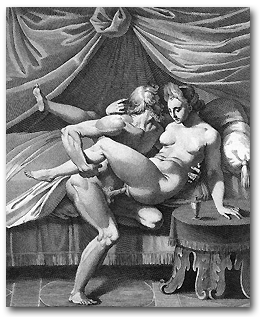
Jupiter et Junon ~ Agostino Carracci (1557 - 1602) |