Syphilis is by far the more lethal, as it has three distinct stages and in its third, or tertiary, stage can cause blindness, dementia, organ failure and death. It was often referred to as “the pox” in medieval Europe since it sometimes caused running sores and blisters to appear on the skin in its later stages, which could occur up to twenty years after initial infection. It was endemic in Europe throughout the Middle Ages and then became pandemic at the end of the 15th century when it was brought to the new world with the sailors who travelled with explorer Cristobal Colon/Christopher Columbus. It was not actually referred to as syphilis until 1530, and not known to be a singular disease until the late 19th century; it was thought to be characterized by a range of symptoms and only gradually did it become clear that it was transmitted sexually (probably when multiple partners of the same person, a prostitute or seducer perhaps, all were afflicted with the same symptoms).
Some have theorized that AIDS is in fact one variant of the tertiary stage of syphilis, because the latter stages of both diseases are markedly similar; this theory was more pervasive when the primary victims were sexually-promiscuous gay men. But now that it is known the disease can be passed along in utero (in the birth canal from other to child) and through contact with open wounds or the blood stream (as with cuts on the hands or in the mouth), this theory is less credible. But since syphilis has such a notable history and has been so pervasive around in Western culture for so long, it is perhaps natural to see some similarity in these two epidemics, both of which have dramatically affected the course of human history.
For many years syphilis and gonorrhea were not understood to be separate diseases, since their symptoms in men were often similar (burning sensation upon urination, genital sores, general weakness and malaise). In women, both diseases often had no symptoms at all. Gonorrhea was called “the clap” just as syphilis was “the pox,” and some doctors merely considered gonorrhea the early stage and tertiary syphilis the late stage of the same infection. This was further confused by the fact that is was possible to have both diseases at the same time. In Europe syphilis has a devastating effect upon the fabric of society, since it was often found among the aristocracy and within royal families, particularly in France and England. Because the disease affected reproductive capability in both men and women, sometimes the very future of the royal line was in jeopardy.
Syphilis arrived in Italy in 1495 with the campaign of Charles VIII against the Spaniards for the control of Naples. The Italians called it the French sickness while the Italians called it the Neopolitan sickness. Within a decade of its first outbreak in Europe it became an epidemic and this continued for two centuries. Christian ideology saw syphilis as divine retribution for sinfulness (this is where the term “venereal” disease comes from, similar to “venial” sins). Those suffering from the “pox” (which could take a long time to kill someone) were often ostracized just as lepers were.
Some well known public figures contracted the disease and often died in poverty and shame as they were shunned by their families and friends; among the unfortunate victims was brilliant writer and philosopher John Wilmot, the second Earl of Rochester. His womanizing ways and fondness for alcohol led to his early death at 33; his life story is chronicled in the wonderful new film starring Johnny Depp The Libertine.
Despite syphilis’ presence in the “new world” from the late 15th century, the recorded history of STDS is relatively recent. There was a Congressional order issued in 1778 that imposed fines on any enlisted man admitted to hospital with a venereal disease. In the 1800s, prostitution and venereal disease became very large problems, especially in he city of New York which grew in size, density and population quickly with the dawn of the industrial revolution and the rise in immigration. In 1874 it was estimated that 1 in 20 people in the United states were infected with syphilis. Life expectancy for prostitutes infected with the disease was five years at best; high rates of alcoholism also added to the mortality rate among young women in the city slums. This was a stark change from the presence of the disease among the wealthy and social elite in Europe.
The more strict social morality which characterized the Victorian Era may have helped slow the spread of syphilis somewhat, and the First World War also saw a decline in venereal disease, but mainly because so many young men were killed. Nevertheless, syphilis levels reached their height in the U.S. in the decade of 1910 through 1920, which straddles the war. In 1918 nearly 1 million men were rejected by the military as being unfit for service because they had syphilis; this sad irony points to the two main causes of death among young men in the early 20th century, along with the influenza outbreak of 1914.
Sssh Interesting Facts!
Who Had Syphilis!
Keys: S - suspected case; † - died of syphilis
|
|
King Charles VIII of France (1470 - 1498) S
Christopher Columbus (1451-1506), S †
Philip II (1527–1598), King of Spain S †
Henry VIII (1491-1547), King of England
Mary I of England / Bloody Mary (1516 - 1558) S
King Edward VI (1537 - 1553) Henry's son S
François I (1494-1547), King of France
Charles V (1500-1558), King of Spain and Holy Roman Emperor
Henry Stuart, (Lord Darnley) (1545-1567), 2nd husband of Mary Queen of Scots
Ivan the Terrible (1530 - 1584) S Ivan IV of Russia
Giacomo Casanova (1725-1798), adventurer, writer, womanizer
Manuel Maria Barbosa du Bocage (1765-1805), poet †
Ludwig van Beethoven (1770-1827), composer S †?
Franz Schubert (1797-1828), composer †
Heinrich Heine (1797-1856), poet †
Gaetano Donizetti (1797-1848), composer
Abraham Lincoln (1809-1865), president of U.S.A. S
Robert Schumann (1810-1856), composer †
Mary Todd Lincoln (1818-1882), wife of Abraham Lincoln S †
Charles Baudelaire (1821-1867), poet†
Gustave Flaubert (1821-1880), writer
Camilo Castelo Branco (1825-1890), writer
Leo Tolstoy (1828-1910), writer |
Édouard Manet (1832-1883), painter†
Paul Verlaine (1844-1896), poet †
Friedrich Nietzsche (1844-1900), philosopher †
Paul Gauguin (1848-1903), painter †
Guy de Maupassant (1850-1893), writer †
Vincent van Gogh (1853-1890), painter
Oscar Wilde (1854-1900), writer S
Arthur Rimbaud (1854-1891), poet
Jean Lorrain (1855-1906), writer
Hugo Wolf (1860-1903), composer †
Frederick Delius (1862-1934), composer †
Henri de Toulouse-Lautrec (1864-1901), painter †
Scott Joplin (1867/8-1917), musician †
Vladimir Lenin (1870-1924), communist leader S
James Joyce (1882-1941), writer
Benito Mussolini (1883-1945), dictator
Karen Blixen (1885-1962), writer
Adolf Hitler (1889-1945), dictator S
António Botto (1897-1959), poet
Al Capone (1899-1947), gangster †
Howard Hughes (1904-1976), billionaire
William S. Burroughs (1914-1997), writer
Idi Amin (1924 - 2003) President of Uganda † |
Copyright © 2007 Sssh.Com • All International Rights Reserved
You may not distribute or reprint this article, in whole or in part,
without express permission from Sssh.Com
|
Cover Art
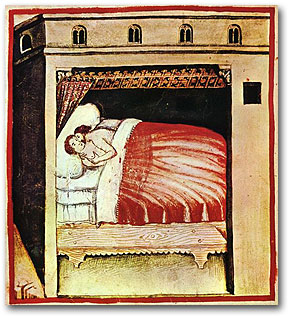
From the Tacuinum Sanitatis (XIV century)
|